







Travel to former USSR

Destination
Tour
Dates
Duration
Price
Comments
Russia RIVER CRUISE FROM MOSCOW TO ROSTOV-ON-THE-DON (ROSTOV-ON-DON) ON M/S 'GEORGY CHITCHERIN' (14 DAYS / 13 NIGHTS)
2006: September 26 14 days / 13 nights $0 View Gallery
Order request
The description of tour

RIVER CRUISE FROM MOSCOW TO ROSTOV-ON-THE-DON (ROSTOV-ON-DON) ON M/S 'GEORGY CHITCHERIN' (14 DAYS / 13 NIGHTS)

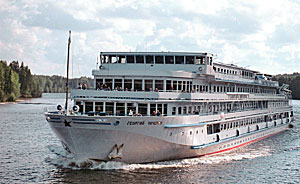
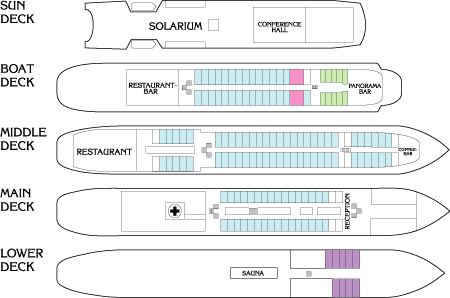
The ship is specially designed for the inland waterways cruising, and features outside cabins that allow picturesque views of the passing countryside. All units are comfortably furnished, air-conditioned and have private showers.
Highly professional and experienced crew takes great pride in their ship and maintains it in excellent condition. The dining service offers Continental, Russian and Ukrainian cuisine, as well as gourmet specialties of the visited regions. Most meals are served on board in a warm homelike atmosphere of the ship's dining room. Service personnel are well trained and eager to offer assistance. Public areas may include bars, small souvenir shops, music salon and/or beauty parlor. Laundry service is also available.
Our government-licensed English speaking tour guide will accompany you during on shore excursions and will fill you in on the history, mythology, and art of the places you visit. In addition to extensive sight-seeing outings, our on board entertainment program includes daily musical performances, lectures by professional guest speakers, folk shows, Russian and Ukrainian language lessons, passengers talent shows, outdoor shashlyk (shish-kabob) picnic at recreation stops, Grand Tea Ceremony, Blini and Vodka tasting.
Day 1-3: MOSCOW
Transfer from the airport to ship*, city tour by bus, Kremlin tour with 1cathedral.
   Moscow was founded as a fortress by Yury Dolgorukiy in 1147 and now it is among the biggest cities in the world. Kremlin is the historical center of Moscow. The heart of it is Armory Chamber - the treasury of all Tsars and Grand Dukes of Russia. Here you can visit Blagoveschenskiy Cathedral, where the works of famous Russian icon-painter Andrew Rublev are presented to the public.
Famous Russian Giants can be found here as well: Tsar Bell and Tsar Canon are the unique masterpieces of Ancient Russian Foundry. Red Square is a symbol of Russia. The central Spasskiy Tower with the famous Kuranty Clock and St.Bazil' Cathedral are among places of interest when visiting Moscow.
There are more than 100 museums in Moscow. Tretiakov Art Gallery and Pushkin Art Museum have the richest collections of paintings. There is a famous Ascention Church (16 th century) which is situated in the open sky museum Kolomenskoe.
There are 30 theatres in Moscow, among them is the biggest Bol'shoi Theatre.
Ostankinskaya TV Tower is among Moscow miracles. Its height is almost 540 meters. Moscow Subway Stations, resembling palaces, also attract many tourists.
Moscow University named after the famous Russian scientist M.Lomonosov is a pride of Moscow.
Moscow channel built by many political prisoners in 1937 was named after the city in 1947.It connects Moscow with Volga River. Later, in early fifties, all 5 seas: White Sea, Baltic Sea, Black Sea, Azov Sea, Caspian Sea were connected by Volgo-Donskoi and Volgo-Baltiyski Channels.
Day 4: UGLICH
City tour, Kremlin, Dmitry on the Blood Church, Transfiguration cathedral.
   Uglich is a town in the Yaroslavl province, a river port and a railway station. It produces clocks, watches, cheese and other milk products. Heavy machinery is repaired here. There is a hydroelectric station. The population numbers 39,000. The town has a museum of art and history.
The name of Uglich is a derivative of “ugol” (“a corner”). The Volga makes a sharp bend at this place, forming a corner, or “ugol”, hence the name.
Founded as early as 937, it was first mentioned in chronicles only in 1148. A local legend says that the town existed in the days of Holy Princess Olga, Equal-to-the Apostoles. It served as the capital of the Uglich principality from 1218 till 1238 when it was seized and devastated by the Mongols who killed most of its population. The rest were taken prisoners or fled to the dense forest surrounding the town. In the 14th century Moscow began uniting Russian lands and Uglich was annexed to the Moscow principality. In 1371 it was burnt to ashes by the prince of Tver who struggled with Moscow for supremacy.
In the 15th century the town prospered and even coined its own money. After Ivan the Terrible’s death, his son Prince (Tsarevich) Dimitry, the last in the Rurik dynasty, was sent to Uglich with his mother and was killed here at the age of eight in 1591 in uncertain circumstances. His death was not only a tragedy for his family, it was followed by many troubles in Russia, such as internecine conflicts and a Polish invasion. Three false pretenders to the Moscovite throne (one after another) claimed to be Prince Dimitry. They are known as False Dimitrys.
A team of restorers has been working in the town’s historical center since 1952. As a result, many old buildings have been saved from destruction. According to the plan for Uglich’s development and construction, recently approved by the local authorities, its historical center will be preserved intact.
Day 5: KOSTROMA and YAROSLAVL
City tour by bus in both cities, Ipatiev monastery in Kostroma, Trinity cathedral in Kostroma, bus transfer to Yaroslavl, Transfiguration monastery and church of Elyjah the Prophet in Yaroslavl.
   Kostroma is as old as Moscow. Located on the left bank of the Volga River, it abounds in magnificent monuments of old architecture. Its picturesque suburbs have long been a source of inspiration for many Russian artists.
At the confluence of the Kostroma and Volga Rivers rise the white stone walls and golden cupolas of the Ipatievsky Monastery. It was founded in the latter half of the XIII century to protect the approaches to the city from the upper reaches of the Volga.
In 1958, a unique open-air museum of wooden architecture was set up at the walls of the Ipatievsky Monastery. Churches, old houses, barns, water- and windmills, and small bathhouses were brought from various villages in the Kostroma Region. Among the exhibits, the Church of the Synaxis of the Virgin (1552) from the village of Kholm and the Church of the Transfiguration (1713) command particular attention.
The city of Yaroslavl was founded XI century by prince Yaroslav the Wise on confluence of the Volga and the Kotorosli. Yaroslavl is well known for the beauty of its temples of XVII century, saved since “golden century” of Yaroslavl in the period when skilful architects and icon-painters were working here. Amazing are the frescoes of Il’ya the Prophet church situated on the main square. Nikola Nadein church with carving gilded Ikonostasis executed in baroque style and unique fifteen-dome Ioan Predtechi church are among ceremonial monuments of the Yaroslavl architectural school.
The Spaskiy monastery remained for a long time as a main cultural and spiritual centre of Yaroslavl. The rarest monuments of the XVI-XVII centuries are kept in its limits. Wooden walls and towers were elevated in the XVI century. The central part of the Spaskiy monastery ensemble is the ancient building of Yaroslavl.
At the present time there is a historic-architectural reserve museum in Spasskiy monastery, created in the result of joining historic-natural (1864) and historic (1895) museums. An International Festival of choral and bell music is held on the museum territory.
Day 6: NIZHNI NOVGOROD
City tour by bus, Kremlin.
   Nizhnyi Novgorod was founded in 1221 by the Prince of Vladimir, Yuryi Vsevolodovich. It is a large river port, trade and cultural centre. One of the most ancient chronicles of Russia was written here, in Pechersky monastery, written in 1328-30. Later it was known as Lavrentyevskaya chronicle.
There are also numerous monuments of history and architecture. Some of them are the Kremlin with its Fortress towers (1500, 1508-1511) and Arkhangelsky Cathedral, built by Lavrenty and Antip Vozoulin (1624 - 1631).
Day 7: KAZAN
City tour by bus, Kremlin.
   Kazan is the capital of Tatarstan and is on of the main industrial and cultural centers of region belonging to the Volga river. The architecture of the city is very interesting. It combines in a unique way the styles of Russia, Europe and Asia.
Day 8: ULIYANOVSK
City tour by bus, Lenin Memorial Complex.
   Ulyanovsk was founded in 1648 on the site of a Tatar village as a strongpoint to defend Russia's southern frontier. It also developed as a trade center. It was taken by the Cossack leader Stepka Razin in 1670, was the scene of fighting during the Pugachev insurrection of 1773-74, and was virtually destroyed by fire in 1864.
The city was the birthplace of V. I. Lenin, the founder of Soviet Russia. The house where Lenin was born and the school that he attended became national shrines of the Soviet Union. The city, formerly called Simbirsk, was renamed in 1924 in honor of Lenin (whose original name was Vladimir I. Ulyanov).
Day 9: SAMARA
City tour by bus.
   The cityof Samara is situated on a high left bank of the Volga river, where the river Samara flows into it. It's a large transport station, river port and airport. The population of Samara is 1 million people. The area of the city is 330 sq. km.
It was founded as a fortress in 1586 to protect the lands from the raids of the Tatars of Crimea. Samara was first mentioned in the chronicle in 1623. It was a trading center of bread, wool and leather.
Day 10: SARATOV
City tour by bus.
   Saratov was founded in 1590 as a fortress to protect the Volga rout from the raids of the tribes of nomads. Since the 17th century it has become a staging point for water and land routs also as a fish and salt trading center.
Saratov is a large river port and a road junction, situated on the right bank of the Volga river. The population of the city is 904 thousand people.
Day 11: VOLGOGRAD
City tour by bus, Mamayev Mound.
   The city was founded in the sixteenth century on an island, opposite the place where the river Tsaritsa flows into the Volga river, to protect the water routs where the Volga meets the river Don.
Day 12: ON THE WATER
Entertainment on board.
Day 13-14: ROSTOV-ON-THE-DON
City tour by bus, transfer from the ship to the airport*.
   Rostov-on-the-Don was founded in 1593 on the right bank of the Don River, 46 km far from the place where it flows into the Sea of Azov. At that time appeared the customs-house of Temernik, contoling the flow of goods from the Caucasus into the centre of Russia. Later, a fortress to defend the south border was established there. Owing to its advantageous transport position, the city had a rapid growth of industry. After the railway linking the town of Ordjonidikdze (now Vladikavkaz) to the centre of Russia was built, Rostov-on-the-Don was called “Gate of the Caucasus”.
The modern Rostov is one of Russia`s biggest cities. It`s inhabited by 1 mln people. It`s a large political, economic and cultural centre of the south of Russia, an important trunk line.
 
Notes: * For a groups of 15 or more.

Our Projects
Our partners
CLIA - Cruise Lines International Association (CLIA) is the world?s largest cruise association and is dedicated to the promotion and growth of the cruise industry.
ASTA – American Society of Travel Agents (ASTA) is an association of travel professionals and the companies whose products they sell, providing education, training, representation, and advocacy.